Mechanized wheat harvesting and mechanized rice harvesting are quite different from one another. The construction of the harvester, the time of harvesting, the technique of harvesting, the operation of the harvester, and subsequent processing are five factors that will be described in depth below.
1. The harvester's structure
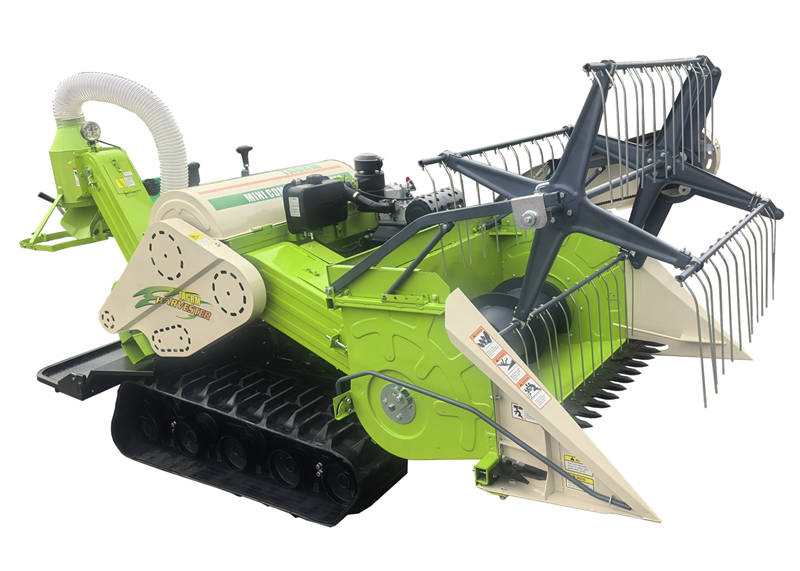
The rice harvester has a more intricate construction than the wheat harvester. Since rice grows in a moister environment than wheat does, rice harvesters must be able to adjust to the soil and weeds in paddy fields. For instance, crawler rice harvesters outperform wheeled harvesters while passing.
Moreover, improved ear cleaning and separating devices are required for rice harvesters. There are more cleaning needs for rice. The rice harvester's cleaning system typically involves several processes, including vibrating screening, wind blowing, and gravity sorting. Due to their tiny size and tight attachment to the ears of rice, rice grains must first be shaken out of the ears by vibration during cleaning before the contaminants are separated from the grains by wind blowing and gravity sorting. Also, the design and adjusting of the cleaning device must be more exact and painstaking because the cleaning effect of the rice harvester has a significant impact on the quality and market value of rice.
In contrast, the wheat harvester's cleaning mechanism is rather straightforward. The wheat kernel is quite firm and quickly slips off the stem, while the wheat ear is somewhat loose. As a result, using vibrating screening and wind blowing, the wheat harvester's cleaning equipment primarily separates contaminants like wheat grains and straws. As the cleaned wheat kernels are being kept, the straw is being ejected from the machine.
2. Harvesting season
Wheat and rice both have varied harvest seasons. Whereas wheat is separated into winter wheat and spring wheat and may be harvested only once or twice a year, rice is grown across a very big area and can be harvested one to three times each year. Wheat's very short growth cycle makes for an early harvest, and it should be done as soon as midday or as early in the evening as feasible.
3. The harvesting technique
Reel and cutter cutting, or harvesting by chopping straw, is the typical technique used by rice harvesters. The wheat harvester often uses the cutting knife technique, which involves chopping off the wheat stem's blade. As a result, it's important to alter the height of the harvester cutter while harvesting wheat.
4. How to operate a Harvester
Since rice fields are quite complicated, operators must be skilled at operating tasks including starting, stopping, moving ahead, going backward, and unloading the harvester in difficult terrain. One simply has to get familiar with the harvester's fundamental functions since the wheat harvester is comparatively easy to operate.
5. Follow-up processing
The subsequent processing of rice is more difficult than the subsequent processing of wheat, and the cut rice requires drying, threshing, screening, and several other procedures to produce the rice we are acquainted with. Contrarily, wheat merely has to be cleaned and dried.
In conclusion, there are significant differences between the mechanical harvesting of wheat and rice. Hence, in actual applications, it is important to choose a harvester and harvesting technique that is appropriate for certain crops and surroundings. To guarantee that automated harvesting proceeds without a hitch and to boost the effectiveness and caliber of agricultural produce, it is also vital to increase the technical proficiency of operators.