Strengthening the field management of cassava is very important to increase the yield of cassava. Cassava has a long growth cycle. If you do not pay attention to field management, it will cause overgrown weeds, pests, and diseases, resulting in weak seedlings and missing plants, thus reducing production. According to the experience of various places, the field management of cassava mainly focuses on four aspects: checking seedlings and replenishing seedlings, top dressing, control of diseases and insect pests. The specific operation details are as follows:
1. Check for seedlings to fill vacancies
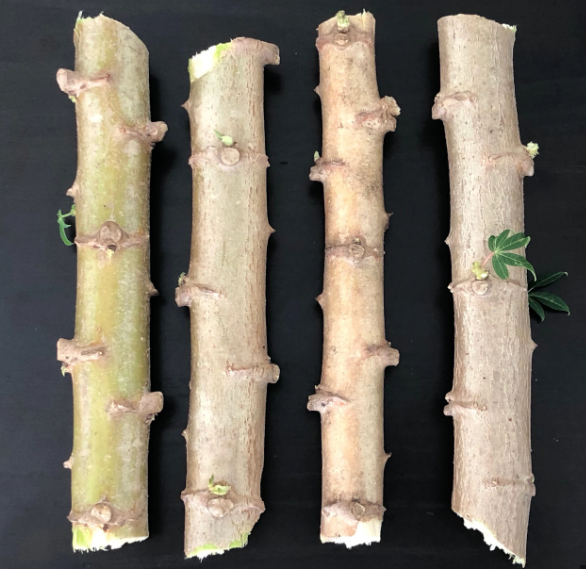
The row spacing of cassava plants is large, the number of plants per mu is small, and the yield of each plant is relatively large. If there are missing plants, it will wasteland and affect production. To ensure full seedlings, seedlings must be checked and filled in time after planting, usually within 5 days after seedlings are filled. If the seedlings are replenished too late, it will be difficult to grow consistently.
There are roughly two methods of supplementation:
1.1 If there are plenty of stems, part of the stems can be reserved for supplementing seedlings. It is best to cut them into 13-15 cm sections at the same time and bury them shallowly on the edge of the ground. If the seed stems are not sufficient, after cutting the seeds, cut off the small seed stems and branches by 13-15 cm, arrange them on the edge of the field, cover them with a layer of loose soil, let them germinate, and prepare for seedling supplementation.
1.2 For plants with more than two seedlings that have germinated in the ground, when the height of the seedlings is 20-33 cm, use a sharp knife to cut off the excess seedlings from the ground on the rainy day, and cut off the leaves to reduce water evaporation and use it as a supplementary seedling. Root water should be poured immediately after replanting for the above two methods to ensure survival. After surviving, the fertilizer should be applied one more time to catch up with the growth of ordinary seedlings.
2. Topdressing
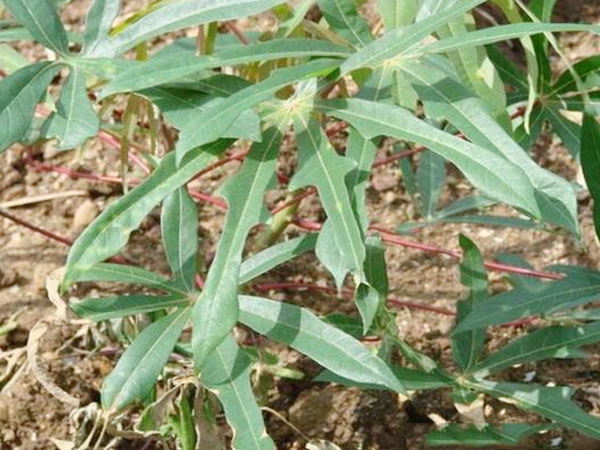
Cassava is a crop with a long growth period and high yield. Based on applying sufficient base fertilizer, topdressing fertilizer is used to meet the needs of its growth to achieve the purpose of high yield. Generally topdressing twice. The first time is one month after emergence, that is, when the tubers begin to form, and the second top dressing is carried out one and a half months apart. Generally, topdress human excrement or manure or compost mixed with phosphate fertilizer and turf mud. Pay attention to the application of potassium fertilizer. Necessary fertilizers should be added for plants with yellow leaves and weak seedlings. Fertilization should avoid contact with the stem and its lower root group. It is best to apply it about 10 cm on both sides of the stem. Applying too far is not conducive to the absorption and utilization of roots. Cover the soil with 5 cm after application, especially for the application of ammonium nitrate and ammonium bicarbonate, it is necessary to cover with thick soil, even if a drench is applied, it should also be applied in ditches, and the soil should be covered after application to exert the fertilizer effect.
3. Disease and pest control
Cassava has fewer pests and diseases, and the common ones are as follows:
3.1 Cassava bacterial angular leaf spot
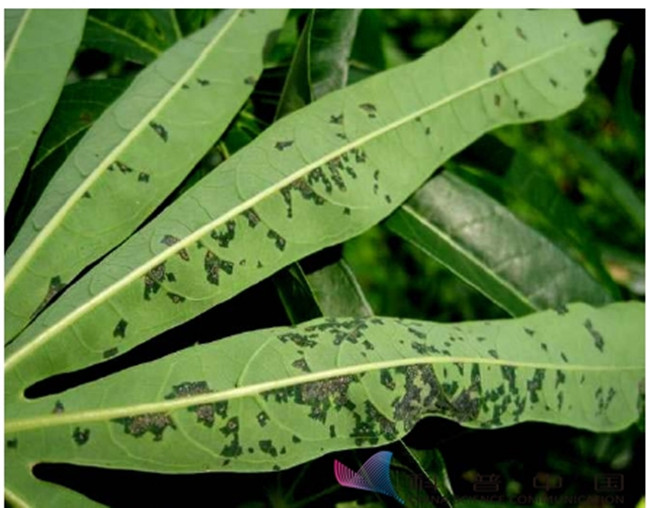
The occurrence is relatively common, and the local green stem species is more serious. The lesions of this disease are scattered on various parts of the leaves. They are small water-soaked dark green spots at first, and then gradually expand to irregular polygonal lesions, and finally, the lesions turn dark brown. The leaves with more diseased spots all turn yellow, and when severe, the leaves fall off, and sometimes most of the whole plant leaves fall off, leaving only a few tender leaves.
3.2 Cassava blight
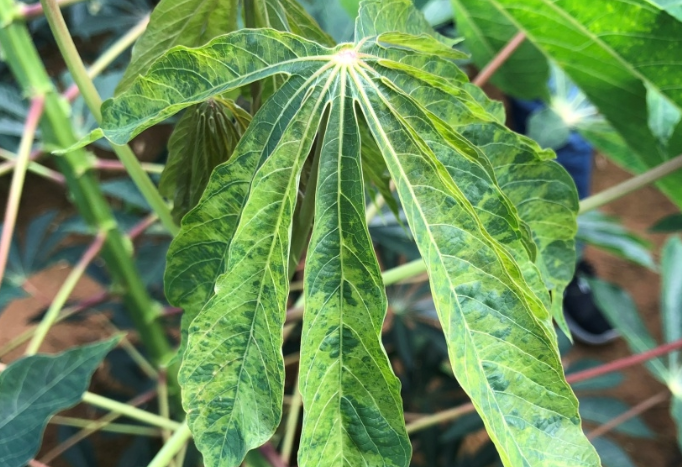
Lesions mostly occur on the tips of leaves and often occur on the edges of leaves. The lesions are light green at first, then gradually gray-green, as if scalded by boiling water, and finally dark brown, so that they dry up and shatter. As the lesion gradually expands outward, the color of the inner layer and edge of the lesion changes from time to time, thus forming annular plaques with inconsistent colors.
3.3 Cassava leaf spot
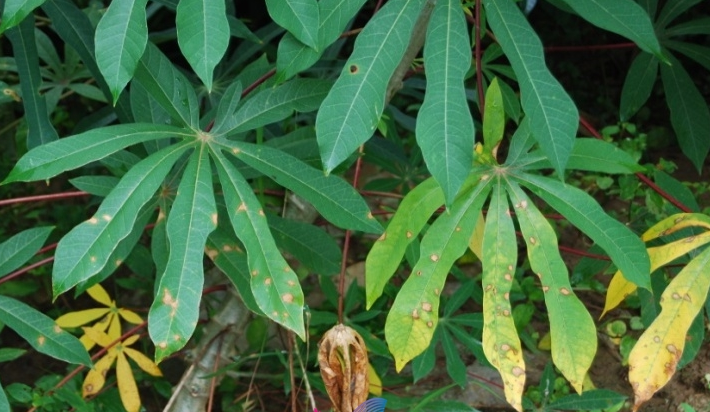
The lesions are born on all parts of the leaves, which are light brown and round at first, and then dark brown and nearly round, as big as soybeans. The lesion is off-white on the back of the leaf, and the edge of the lesion is darker on the front or back of the leaf. Sometimes this color will penetrate the veins of the leaf. At this time, it looks like a drop of light ink dripping on the leaf from the back of the leaf. Same. The lesions are finally dark brown and dry, but the lesions on the back of the leaves are still off-white. Sometimes the lesions become dry and broken into round holes as big as soybeans. There are not many diseased spots on each leaf, generally 4 to 5, and as many as 14 to 15. The leaves with diseased spots are easy to turn yellow and fall off, which has a great impact on the growth of cassava in the later stage. These three diseases mostly occurred from April to May, gradually became more severe from July to September, and did not stop developing until October. Currently, there is no effective chemical control.
The main control methods are 1. Breeding and popularizing disease-resistant varieties; 2. Implementing crop rotation; 3. Strengthening cultivation management, applying more potassium fertilizers to improve disease resistance; 4. Strengthening field inspections to find the disease center in time and remove the diseased leaves Burn it (especially the epidemic disease) to prevent the damage from spreading; 5. Leaf spot disease can be sprayed with Bordeaux mixture made of 1 part of copper sulfate, 1.5 parts of quicklime, and 150 parts of water to inhibit the occurrence of the disease.
3.4 Big cricket
Most of them are dispatched in the evening to bite off the seedlings, resulting in missing plants. The best way to control it is to find the cave of the big cricket, pry open the loose soil at the entrance of the cave, sprinkle a little 5% chlordane powder or other contact pesticides on the side, and then plug the entrance of the cave with some grass (do not block it to death), so that When the big cricket comes out of the hole, it touches the medicine and dies. If there is no pesticide, you can add some kerosene or waste diesel oil to plant ash, knead it into finger-sized pellets, put one in each hole, and then wash the pellets into the hole with water. The pests will die soon after touching the oil.
3.5 Termites
Termites bite the stem cortex or new roots. In areas with termites, prevention should be given priority.
3.6 Starscream
Often damage cassava leaves. Adults are very small spiders, red flesh in color, multiply quickly, and often form webs on the back of leaves to cause damage. When the damage is serious, the leaves are yellow and easy to fall off, and even the whole plant becomes a bare rod.
Control methods: 1. Spread lime and sulfur powder; 2. Spray with 0.3% Baume lime sulfur mixture; 3. Spray with 500 times trichlorfon or 800 times dichlorvos.